
Getting Your Confidence Back After Losing a Tooth
Losing a tooth as an adult brings up a strange mix of emotions — a little embarrassment about how it happened, frustration about what to do next, and often a fair amount of self-consciousness about how it looks in the meantime. Whatever the cause, whether it’s an old filling that finally gave out, an injury, or gum disease that progressed further than expected, the gap left behind tends to cause more problems the longer it’s ignored.
Long-term tooth replacement through dental implants in Las Cruces is designed to solve that problem permanently, and Dr. Kim Martin’s team has walked plenty of patients through the process from the first consultation to the final, completed restoration. Rather than relying on neighboring teeth for support the way a bridge does, an implant replaces both the root and the visible tooth, creating a result that functions and looks remarkably close to natural.
Why a missing tooth causes more problems than people expect
It’s easy to assume a single missing tooth, especially one toward the back of the mouth, isn’t a big deal. In practice, the gap tends to set off a chain reaction. Neighboring teeth can gradually shift into the empty space, throwing off your bite alignment over time. Chewing becomes harder or shifts unevenly to the other side, sometimes leading to jaw discomfort down the road. And the jawbone itself, which relies on the stimulation of a tooth root to maintain its density, can begin to shrink in the area where the tooth used to be, a process that can also affect the shape of your face over time if left unaddressed for years.
How dental implants address the problem at its root
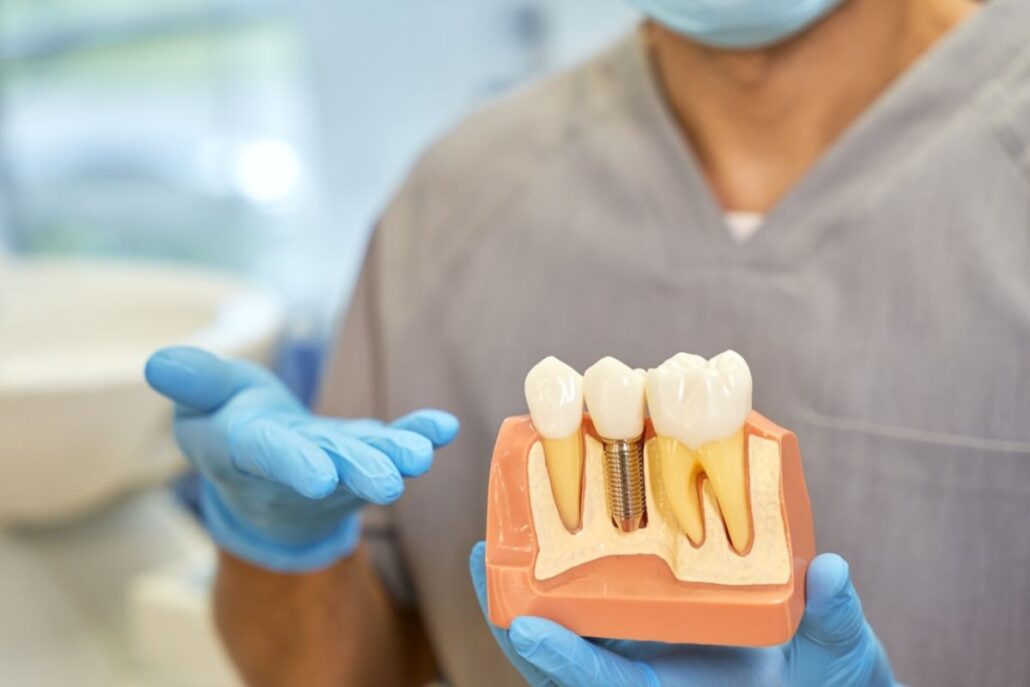
The process starts with a titanium post, which is surgically placed into the jawbone where the tooth used to be. Over the following few months, the bone gradually fuses with the implant post in a process called osseointegration, creating a stable, secure foundation. Once that healing is complete, an abutment is attached, followed by a custom crown designed to match the shape, size, and shade of your surrounding natural teeth.
Why so many patients choose implants over other replacement options:
- They don’t require grinding down or altering healthy adjacent teeth, unlike a traditional bridge
- They help preserve jawbone density, preventing the gradual bone loss that follows tooth loss
- With proper care, they’re designed to last for decades rather than needing frequent replacement
- They function like a natural tooth for biting and chewing, without special dietary restrictions
- They blend in visually, making it hard for anyone to tell which tooth was replaced
- They eliminate the need for the adhesives or nightly removal that come with a removable denture
What determines whether someone is a good candidate
Not every situation looks the same, which is why the process typically begins with a thorough evaluation, including imaging to assess how much healthy bone remains in the area where the tooth is missing. Patients who’ve been missing a tooth for a long time sometimes have reduced bone density in that area, since the bone naturally resorbs without the stimulation a tooth root normally provides. In those cases, a bone graft is sometimes recommended first, adding a bit of time to the overall process but significantly improving the long-term stability and success rate of the implant once it’s placed.
Overall health also factors into candidacy, including things like gum health and any conditions that might affect healing. Dr. Martin’s team reviews all of this during the initial consultation, so patients have a clear, realistic picture of their options before moving forward with any part of the process.
What the full timeline typically looks like
From the initial evaluation to the final, completed crown, the process generally spans a few months. The first stage involves placing the implant post itself, a relatively short procedure performed under local anesthetic, with sedation options available for patients who prefer a calmer experience. After placement, a healing period of a few months allows the bone to fully integrate with the implant before any additional pressure is placed on it. Once that integration is confirmed, typically through follow-up imaging, the abutment and final custom crown are attached, completing the restoration.
For patients who need a bone graft first, the overall timeline extends by a few additional months, since the graft itself needs time to heal and strengthen before the implant post can be placed securely.
Why this matters for Las Cruces patients specifically
Las Cruces has a strong sense of community, and missing teeth tend to come up more in conversation here than people might expect, whether that’s from an old injury during high school sports, years of untreated dental issues, or simply the natural wear that comes with getting older. NMSU’s presence in town also means a fair number of younger patients dealing with the aftermath of an accident or injury, looking for a permanent, natural-looking solution rather than a temporary fix that needs frequent adjustment or replacement.
A few pointers if you’re considering dental implants:
- Don’t assume you’re not a candidate just because you’ve been missing a tooth for years — many patients in that exact situation are still good candidates
- Ask about the bone density evaluation early in the process, since this shapes the entire treatment timeline
- Consider the long-term cost comparison against other options like a bridge, which often needs replacement sooner and can affect healthy neighboring teeth
- If cost is a concern, ask about financing options, since many practices offer payment plans for larger restorative treatments
- Plan for the healing period realistically — rushing the process can affect the long-term success of the implant
FAQs
How long does the full dental implant process take? From placement to the final crown, it typically spans a few months, allowing time for the implant to properly integrate with the jawbone.
Is the procedure painful? Most patients describe recovery as comparable to a tooth extraction, with some soreness that improves noticeably within a few days.
What if I’ve been missing a tooth for a long time already? It’s often still possible to move forward with an implant, though bone density in the area will need to be evaluated, and a graft may be recommended first in some cases.
How does the cost of an implant compare to a bridge? Implants often carry a higher upfront cost, but their durability, along with the fact that they don’t require altering neighboring healthy teeth, tends to make them a stronger long-term investment for many patients.
Can more than one missing tooth be replaced with implants? Yes, depending on how many teeth are missing and the condition of the surrounding bone, either multiple individual implants or an implant-supported bridge might be recommended.
What does long-term care for an implant actually involve? Routine brushing, flossing, and regular dental checkups are typically all that’s needed to keep an implant functioning well for many years.
Will my implant look different from my natural teeth? The custom crown is designed specifically to match the shade, shape, and size of your surrounding teeth, so most people won’t be able to tell which tooth was replaced.
What if I’m nervous about the placement procedure itself? Sedation options are available for patients who feel anxious about the process, and the team can walk through exactly what to expect beforehand to help ease any concerns.
If a missing tooth has been affecting your confidence or your ability to chew comfortably, a consultation is a straightforward way to find out what your options actually look like, and how soon you could have a permanent, natural-looking solution in place.


